
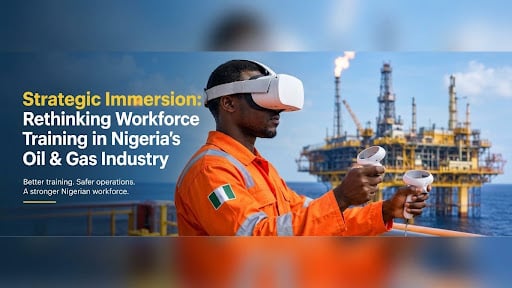
Nigeria’s oil and gas industry is entering a period in which technical expertise, operational efficiency, safety, and local workforce development must work together more closely than ever. As projects become increasingly sophisticated and digital technologies reshape industrial operations, the question is no longer simply how many employees have completed a training programme. It is whether they can apply what they have learned when it matters most.
For an industry where a single operational error can have serious consequences for human life, equipment, the environment, and business continuity, workforce competence cannot be treated as a box to tick. It must be developed, practised, assessed, and continually reinforced.
This calls for a rethink of how organisations approach technical training. Traditional classroom instruction, presentations, written assessments, and supervised practical sessions remain valuable. However, they may not always provide enough opportunities for workers to practise complex procedures, recognise hazards, or make decisions under realistic operational conditions.
Strategic immersion offers another approach. By combining structured learning with realistic simulations, interactive digital environments, and scenario-based practice, oil and gas organisations can give workers opportunities to experience operational challenges before encountering them in the field.
For Nigeria, this approach has implications beyond workplace safety. It could support indigenous capacity development, improve the transition from theoretical education to practical competence, and help organisations prepare their workforce for a more technologically demanding energy sector.
The Workforce Training Challenge in Nigeria’s Oil and Gas Industry
Nigeria’s oil and gas sector depends on a broad range of specialised capabilities, including drilling, production operations, process control, mechanical maintenance, electrical systems, instrumentation, logistics, emergency response, and health, safety, and environmental management.
Developing these capabilities requires more than transferring technical information. Workers must understand how equipment behaves, how operational systems interact, how hazards develop, and how to respond when conditions change.
A technician may understand the theory behind a piece of equipment but still require extensive practice before confidently diagnosing a fault. A new employee may know the steps involved in an emergency shutdown but struggle to execute them under pressure. A safety briefing may explain the consequences of a gas leak without allowing workers to practise identifying warning signs and following the appropriate response procedure.
These are examples of the gap between knowing what to do and being able to do it.
The challenge is not that conventional training is inherently ineffective. Rather, different learning objectives require different methods. Classroom instruction can establish foundational knowledge, while practical exercises and realistic simulations can help learners apply that knowledge in context.
The Nigerian Content Development and Monitoring Board (NCDMB) recognises the importance of developing industry-ready skills and strengthening the capabilities of Nigerian personnel. Its human capital development initiatives include technical, professional, vocational, and other skills intended to improve workforce readiness and indigenous participation in the industry. NCDMB: Human Capital Development.
The opportunity is to strengthen this broader capacity-building effort by paying closer attention to how skills are practised, demonstrated, and measured.
What Is Strategic Immersion?
Strategic immersion is the deliberate use of realistic, interactive learning experiences to help people understand and practise the tasks they will perform in their working environment.
It can involve virtual reality (VR), augmented reality (AR), computer-based simulations, digital twins, interactive equipment models, scenario-based exercises, and supervised practical training.
Virtual reality, for example, can place a trainee inside a simulated industrial facility using a headset and interactive controls. The trainee may inspect equipment, identify hazards, follow a procedure, or respond to an unfolding scenario.
Augmented reality can overlay digital instructions or equipment information onto a view of the physical environment. Computer-based simulations can model operational processes, while digital twins can support training when connected to suitable representations of real equipment or systems.
These technologies are related, but they are not interchangeable. The appropriate solution depends on the training objective, technical requirements, available infrastructure, and consequences of making an error.
The defining principle is not the technology itself. It is the quality of the learning experience and its relevance to the job.
Strategic immersion starts with a specific competency that a worker needs to develop. It then creates a structured opportunity to practise that competency, receive feedback, correct mistakes, and demonstrate improvement.
This makes it different from adopting VR simply because the technology is new or visually impressive.
Why Immersive Training Matters in High-Risk Operations
1. Practising safety procedures without exposing workers to real hazards
Safety training is one of the most promising applications of immersive learning.
In the oil and gas industry, workers may need to recognise hazardous conditions, use personal protective equipment correctly, follow permit-to-work procedures, understand restricted areas, and respond to fires, equipment failures, or other emergencies.
Some of these situations are difficult or dangerous to reproduce during conventional training.
A simulated environment can provide controlled opportunities to practise identifying hazards and making decisions. For example, a trainee could enter a virtual process facility, identify an unsafe condition, select the appropriate response, and receive feedback based on a predefined assessment framework.
The scenario could then be repeated with different conditions, allowing the learner to practise again without creating the physical risks associated with a live emergency exercise.
A 2024 systematic literature review and meta-analysis published in Safety Science examined 52 studies of virtual reality safety training. Its meta-analyses reported advantages for VR over traditional training in knowledge acquisition and retention, although the authors also highlighted limitations in the available evidence, including limited long-term retention measurements.
This evidence supports further evaluation of VR as a training tool. It does not mean every VR programme will outperform every conventional method, or that simulation can replace certified safety instruction and practical competency assessments.
2. Improving procedural understanding
Many industrial tasks involve a sequence of actions that must be performed correctly and in the right order.
Consider equipment isolation and maintenance preparation. Workers need to understand the applicable procedure, identify relevant equipment, recognise potential energy sources, and verify that required safety controls have been applied.
An interactive training scenario can require the learner to complete each stage rather than merely watch an instructor demonstrate it.
If the learner skips a required step, the simulation can explain the error and allow another attempt. Instructors can review performance to identify recurring misunderstandings.
The same principle can apply to inspection routines, equipment familiarisation, maintenance planning, control-room procedures, and other tasks suitable for simulation.
The objective is to make procedural knowledge active rather than passive.
3. Repeating complex scenarios and learning from mistakes
In a conventional training environment, practice opportunities may be limited by equipment availability, time, location, supervision, or the cost of conducting exercises.
Immersive environments can allow selected scenarios to be repeated under controlled conditions. Trainers can vary the sequence of events, introduce unexpected conditions, and assess how learners respond.
For instance, a maintenance trainee might be asked to identify a simulated equipment fault, inspect the relevant components, and choose the next appropriate action. A more advanced exercise could introduce additional information that changes the likely diagnosis.
The learner can practise the process, receive feedback, and repeat the exercise until the required standard is demonstrated.
This approach can be particularly useful for infrequent but consequential events that workers need to understand before they encounter them in real operations.
4. Helping workers understand complex industrial environments
Technical diagrams and written manuals remain essential, but they do not always make spatial relationships or equipment interactions easy to understand.
Interactive three-dimensional environments can help trainees explore equipment, examine components, understand how systems fit together, and visualise the relationship between machinery and its surroundings.
A trainee could explore a simplified production facility, inspect a pump assembly, or follow a process through interconnected equipment.
Such experiences may be useful during onboarding, equipment familiarisation, and preparation for supervised fieldwork. They can also provide a common learning environment for personnel who need to understand a facility before visiting it.
However, the value depends on technical accuracy. Training models must reflect the relevant equipment, procedures, and operational constraints closely enough to support the intended learning objective.
From Training Attendance to Demonstrated Competence
One of the most important changes organisations can make is to reconsider how they measure training success.
Attendance records, course completion, and examination scores can provide useful information. On their own, however, they do not establish that a worker can consistently perform a task safely and correctly.
A stronger approach measures whether the training produces the required competence.
For an immersive programme, relevant indicators could include:
- Hazard recognition: Can the trainee identify the hazards relevant to the scenario?
- Procedural accuracy: Can the trainee complete the required steps in the correct sequence?
- Decision-making: Does the trainee select appropriate responses when conditions change?
- Error patterns: Which mistakes occur most frequently, and do they decrease with practice?
- Knowledge retention: Can the trainee demonstrate the skill again after an appropriate interval?
- Workplace transfer: Does the learning translate into improved performance during supervised practical work?
- Operational relevance: Do supervisors observe improvements in the specific competency the programme was designed to develop?
These indicators should be selected according to the training objective rather than applied as a generic checklist to every programme.
Where appropriate, organisations can establish a baseline before training, assess performance immediately afterwards, and conduct follow-up evaluations to determine whether learning has been retained.
The findings can then inform changes to training content, supervision, and competency development plans.
Immersive technology becomes strategically valuable when it contributes to this cycle of assessment and improvement, not merely when it makes training more engaging.
Where Should Oil and Gas Companies Begin?
Organisations do not need to transform their entire training system at once. A more practical approach is to identify specific training challenges and test whether immersive learning can address them effectively.
Step 1: Identify a clearly defined skills gap
Start with a task or competency that is important, difficult to practise, frequently misunderstood, or costly to reproduce in a training environment.
Potential examples include hazard identification, emergency response familiarisation, equipment inspection, maintenance procedures, and process-system familiarisation.
The choice should be based on actual training needs, not the novelty of the technology.
Step 2: Define what successful performance looks like
Work with experienced operators, HSE specialists, technical instructors, and relevant supervisors to establish the required learning outcomes.
Specify what the trainee should be able to identify, explain, decide, or perform after training.
Where a procedure is safety-critical, ensure that the exercise reflects the applicable approved procedure and is reviewed by competent personnel.
Step 3: Develop an accurate learning scenario
Create the scenario around the selected competency. Depending on the objective, this may require a three-dimensional environment, interactive equipment, branching decisions, performance scoring, or feedback after each action.
Not every task requires a fully immersive headset. A desktop simulation, physical training rig, or instructor-led practical exercise may be more suitable.
Step 4: Run a controlled pilot
Test the training with a defined group of learners and instructors. Evaluate usability, technical performance, realism, learning outcomes, and the practical requirements for delivery.
Gather feedback from the people who will use the programme, including experienced workers who can identify technical inaccuracies.
Step 5: Measure results and refine the programme
Compare the results against the baseline or an appropriate comparison group where feasible.
Look beyond learner satisfaction. Assess procedural accuracy, knowledge retention, observed competence, and the extent to which the training supports the intended operational objective.
Use the findings to decide whether the programme should be revised, expanded, or discontinued.
Step 6: Integrate it into the wider training system
Where the pilot demonstrates value, integrate the programme with existing classroom instruction, practical exercises, competency records, refresher training, and supervised workplace assessments.
Assign responsibility for updating technical content when equipment, procedures, or operating requirements change.
This final step is essential. An immersive module should remain part of a controlled training system rather than becoming a standalone technology demonstration.
Conclusion: Making Competence the Measure of Training
The future of workforce development in Nigeria’s oil and gas industry should not be defined by a choice between traditional instruction and emerging technology. It should be defined by the ability to prepare people for the real demands of their work.
Classroom learning provides essential foundations. Practical exercises build experience. Immersive simulations can add controlled opportunities to practise situations that may be difficult, costly, or unsafe to reproduce repeatedly in the real world.
Used strategically, these methods can work together to strengthen how workers learn, practise, and demonstrate competence.
For Nigerian operators, service companies, training providers, and technology developers, the next step is to identify where current training methods leave gaps, test targeted immersive solutions, and measure the results honestly.
The central question is not whether immersive training looks impressive. It is whether workers become better prepared, whether critical skills can be demonstrated more reliably, and whether the investment supports measurable operational needs.
Ultimately, the most valuable training environment is one that helps people make better decisions when it matters most. Strategic immersion offers the industry another way to build that capability, provided it remains grounded in technical accuracy, professional instruction, and evidence of real learning.