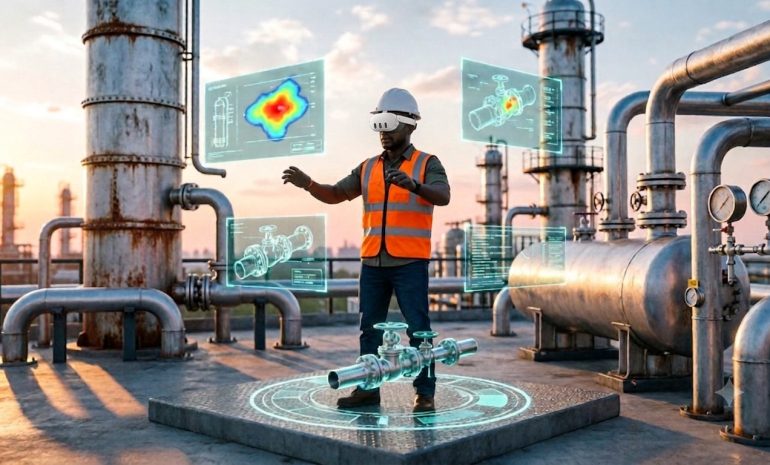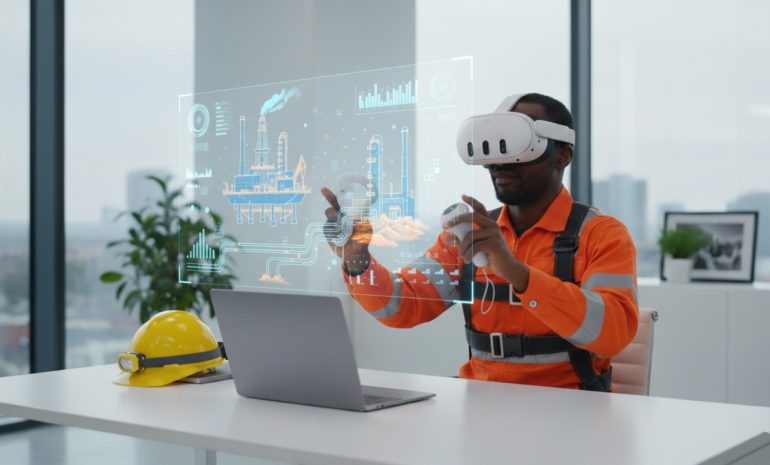
Virtual Reality (VR) training is rapidly gaining traction across Nigeria’s high-risk and skills-intensive industries, including Oil & Gas, Energy, Manufacturing, Construction, Mining, and Telecommunications. As organizations face rising operational costs, stricter safety regulations, and a growing skills gap, VR training presents a powerful alternative to traditional training methods.
However, beyond innovation and immersion, the critical business question remains: What is the return on investment (ROI)?
This analysis explores how Nigerian organizations can evaluate the financial, operational, and strategic ROI of VR training balancing upfront costs against measurable long-term benefits.
Understanding ROI in the Context of VR Training
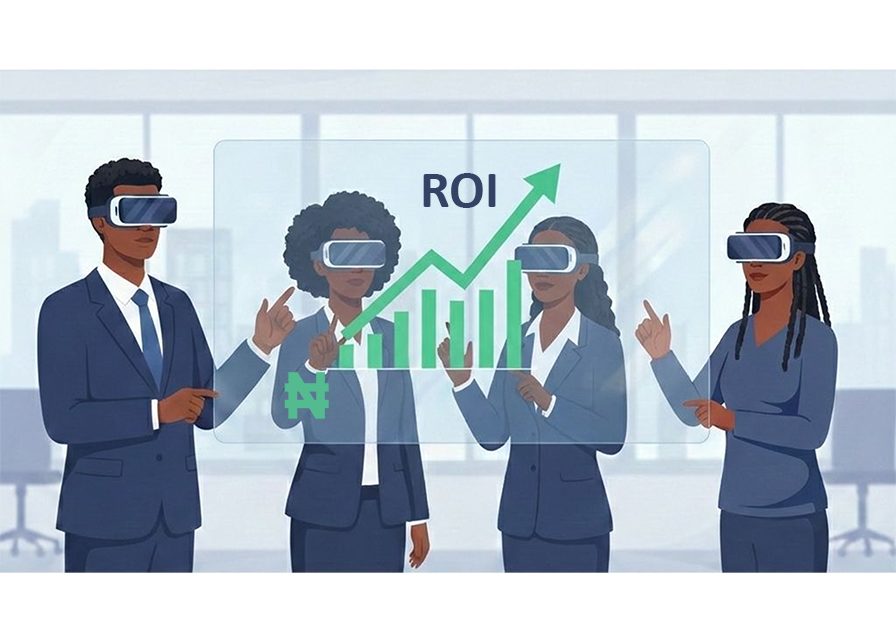
Return on Investment (ROI) measures the value gained from an investment relative to its cost. In VR training, ROI reflects how effectively immersive learning translates into cost savings, productivity gains, safety improvements, and workforce readiness.
For Nigerian businesses operating in challenging environments remote offshore locations, congested urban construction sites, or high-risk industrial facilities ROI analysis helps decision-makers justify VR adoption against conventional classroom or on-site training.
A positive VR training ROI indicates that the financial and operational benefits exceed the total investment, making it a sustainable and scalable solution.
Why ROI Analysis Is Critical for Nigerian Organizations
In Nigeria, training budgets are often constrained by:
- Foreign exchange exposure (hardware, software, consultants)
- High logistics and travel costs
- Regulatory compliance requirements
- Workforce turnover and skills shortages
A structured VR ROI analysis allows organizations to:
- Justify capital expenditure to executives and boards
- Compare VR against traditional training methods
- Align training investments with operational KPIs
- Support regulatory and safety compliance initiatives
For sectors with high-risk , ROI-backed training decisions are no longer optional they are strategic necessities.
Investment Costs of VR Training
Initial Setup Costs
VR training requires upfront investment, which may include:
- VR headsets and tracking hardware
- High-performance computers or standalone headsets
- Custom VR training content aligned with Nigerian operations
- Integration with existing training programs
While these costs may appear high initially, they are often lower than repeated physical training exercises, especially for offshore, hazardous, or geographically dispersed teams.
Ongoing Maintenance and Support
Organizations must also consider:
- Hardware maintenance and replacement cycles
- Software updates and content revisions
- Technical support and device management
- Periodic training scenario updates (regulatory or procedural changes)
In Nigeria, where physical retraining can involve site shutdowns or travel to remote locations, these ongoing VR costs are typically significantly lower than traditional alternatives.
Measuring the Returns: Benefits of VR Training
Improved Training Efficiency
VR allows Nigerian employees to train in realistic simulations without interrupting operations. Workers gain hands-on experience faster, leading to:
- Reduced training time
- Faster onboarding of new staff
- Improved task accuracy
Studies show VR learners complete training up to 4× faster than classroom learners, translating directly into productivity gains.
Cost Savings Over Traditional Training
VR training reduces or eliminates:
- Travel and accommodation costs
- Instructor and venue expenses
- Equipment wear and tear
- Production downtime
For Nigerian companies with operations with offshore platforms, mining sites, or remote substations, these savings significantly boost ROI.
Increased Knowledge Retention and Performance
Research consistently shows that VR-trained employees retain up to 75% of training content, compared to roughly 10% from traditional classroom methods.
Higher retention leads to:
- Fewer retraining sessions
- Better procedural compliance
- Improved on-the-job performance
This is especially valuable in Nigeria’s safety-critical industries, where procedural errors can result in injuries, shutdowns, or regulatory penalties.
Enhanced Safety and Reduced Incidents
VR enables workers to practice hazardous scenarios fires, gas leaks, equipment failures without real-world risk.
For Nigerian industries with high accident exposure, VR contributes to:
- Fewer workplace injuries
- Reduced compensation and insurance costs
- Improved emergency preparedness
- Stronger safety culture
Several organizations have reported measurable reductions in safety incidents after introducing VR-based safety training.
Key Metrics for Calculating VR Training ROI
Nigerian organizations should track the following metrics:
- Reduction in training time
- Decrease in safety incidents and near-misses
- Cost savings from reduced travel and downtime
- Time-to-competency for new hires
- Error reduction and operational efficiency
- Employee engagement and confidence levels
These metrics provide tangible data to support ROI calculations.
How to Calculate VR Training ROI
A standard ROI formula applies:
ROI (%) = ((Net Benefits − Cost of VR Training) / Cost of VR Training) × 100
Where:
- Net Benefits include cost savings, productivity gains, reduced incidents, and operational improvements
- Cost of VR Training includes hardware, software, content development, and maintenance
At scale particularly for organizations training hundreds of employees annually VR training has been shown to outperform traditional training financially.
Factors That Influence VR ROI in Nigeria
Training Quality
High-quality, locally relevant VR content reflecting Nigerian sites, equipment, signage, and procedures significantly improves ROI by increasing engagement and realism.
Scalability
Once developed, VR modules can be reused indefinitely at minimal additional cost. This makes VR especially valuable for large workforces, contractors, and recurring certification programs.
Technology Advancements
As VR hardware becomes more affordable and cloud-based content delivery expands, the cost barrier continues to drop improving ROI for Nigerian businesses over time.
Best Practices for Maximizing VR ROI
To maximize the return on investment from VR training, organizations should:
- Focus on high-risk, high-value scenarios such as safety drills, emergency response, hazardous operations, and critical equipment changeovers.
- Start with a pilot and scale quickly by testing VR with a single team or site, measuring results, and expanding once value is proven.
- Build modular, reusable training content that can be easily updated as procedures, equipment, or regulations evolve.
- Measure impact consistently using KPIs like reduced incidents, training time saved, knowledge retention, and performance improvement.
- Encourage adoption through leadership support by onboarding users properly, sharing early success stories, and involving managers.
- Integrate VR into existing training programs by layering it on top of current corporate training modules to strengthen learning outcomes and ROI.
Conclusion
For Nigerian organizations operating in complex, high-risk, and cost-sensitive environments, VR training delivers measurable ROI through faster learning, improved safety, reduced costs, and better workforce performance.
When backed by clear metrics and aligned with operational goals, VR training is not just an innovation it is a strategic investment that strengthens competitiveness, compliance, and long-term sustainability.
Businesses that adopt VR training today position themselves ahead of the curve in Nigeria’s evolving industrial and workforce landscape.