Mining operations involve risks that workers must understand before entering an active site. From falling rocks and unstable ground to moving machinery, dust exposure and equipment-related incidents, even a minor mistake can have serious consequences.
In Nigeria, where mining activities range from large-scale mineral extraction to smaller operations involving minerals such as gold, tin and limestone, preparing workers to recognise hazards and respond correctly is essential.
Traditional safety training remains important, but classroom instruction alone may not fully prepare workers for the decisions they will face in the field. This is where VR mining safety training and 3D simulation can make a practical difference.
By recreating mining environments and workplace hazards digitally, these technologies allow workers to practise recognising risks, making decisions and following approved safety procedures before applying that knowledge on site.
Why Traditional Mining Safety Training Needs Practical Support
Safety training often involves presentations, written materials, videos and demonstrations led by experienced personnel. These methods help communicate important information, but they can leave a gap between understanding a procedure and applying it in a real working environment.
A worker may understand the importance of maintaining a safe distance from heavy machinery, for example, without having practised identifying an unsafe operating zone in a realistic setting.
Similarly, knowing what to do during an emergency does not necessarily mean a worker will recognise the warning signs or respond appropriately when conditions become stressful.
Mining safety training must therefore go beyond explaining hazards. Workers need opportunities to identify risks, assess situations and practise the decisions required to work safely.
Live demonstrations and emergency drills provide valuable practical experience. However, certain scenarios are difficult to reproduce frequently because of the risks, equipment requirements and operational disruption involved.
VR and 3D simulation offer an additional training environment where these situations can be explored under controlled conditions.
How VR Mining Safety Training Works
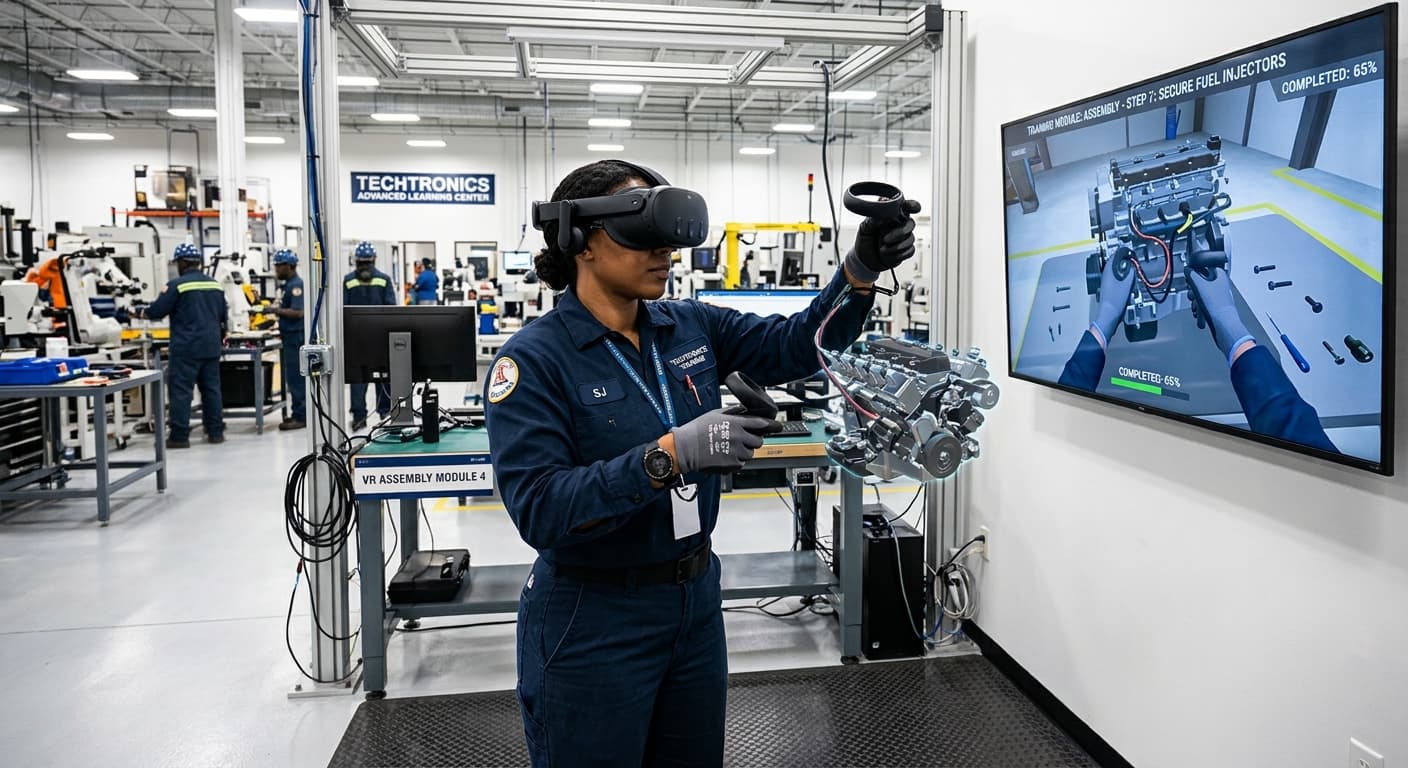
Virtual reality places a learner inside a computer-generated environment that can represent a mine, processing facility, equipment area or underground working space.
Using a VR headset and controllers, trainees can look around, move through designated areas, inspect objects and interact with selected elements of the environment.
Instead of simply watching a safety demonstration, the worker participates in a scenario.
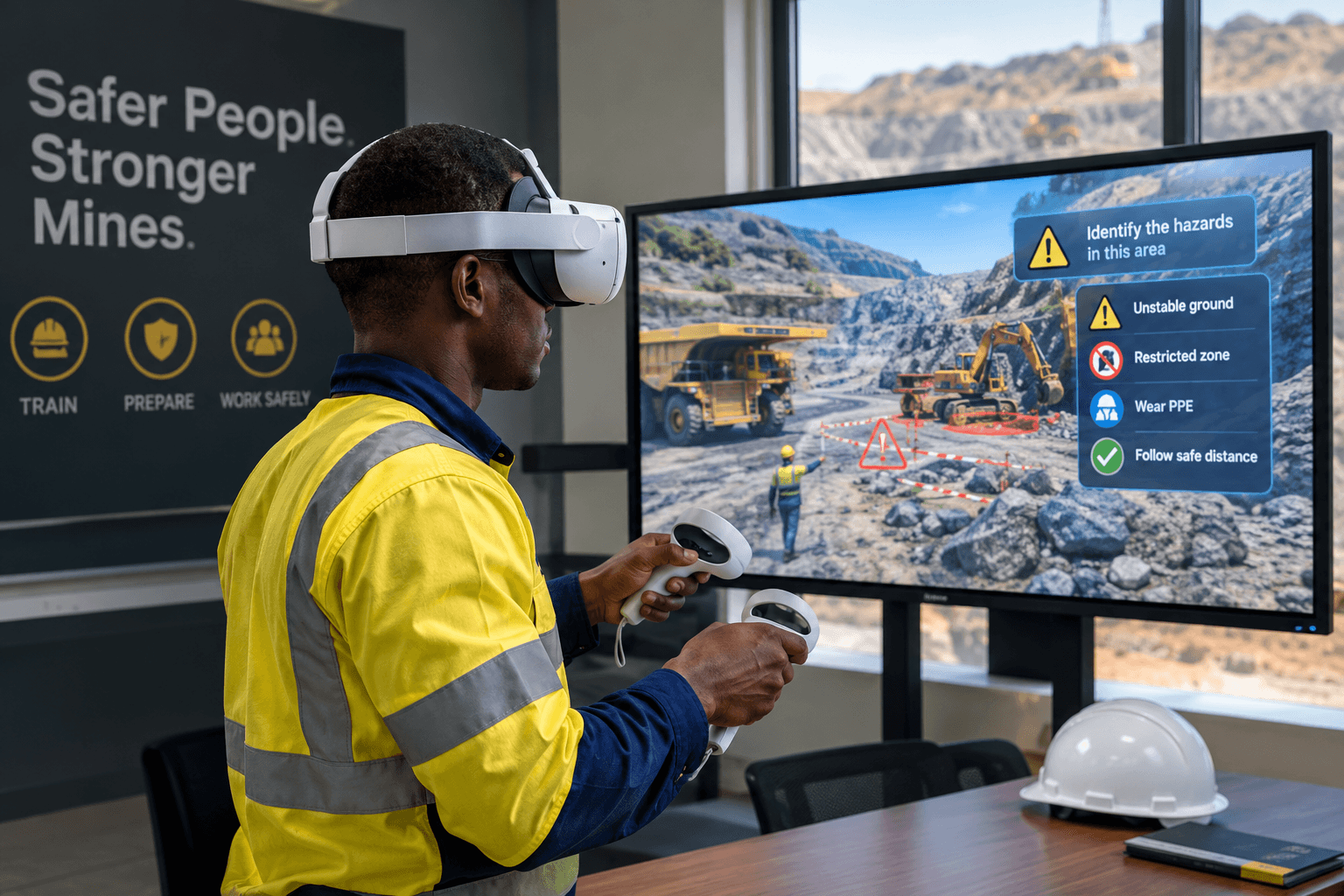
For example, a trainee might enter a simulated mining site and be asked to identify hazards before beginning a task. They may encounter an obstructed walkway, an unguarded hazard zone or a piece of equipment operating in an area where personnel should not be standing.
The trainee must identify the problem and select an appropriate response based on the approved safety procedure.
The simulation can then provide feedback explaining what was done correctly, what was missed and why the decision matters.
Three-dimensional simulation makes this possible by recreating the physical layout of a worksite, including equipment, access routes, working areas and potential hazards. VR adds immersion and interaction, allowing workers to experience the environment from a first-person perspective.
Together, these technologies can turn safety concepts into practical learning activities.
Five Ways VR and 3D Simulation Can Improve Mining Safety Training
1. Hazard Identification and Risk Awareness
Recognising a hazard before an incident occurs is a fundamental part of mining safety.
VR scenarios can introduce trainees to simulated working environments containing hazards they must identify before proceeding. These may include unstable-looking ground, unsafe access routes, exposed moving machinery, poorly positioned equipment or restricted areas.
The training can require the worker to inspect the environment, identify the hazards and explain or select the appropriate corrective action.
For Nigerian mining operations, scenarios can be designed around the conditions, equipment and procedures relevant to a particular site rather than relying entirely on generic international examples.
Repeated practice can help workers become more familiar with the process of observing their surroundings and identifying potential risks.
2. Emergency Response Preparation
Emergencies such as fires, equipment failures, ground instability and other hazardous incidents require workers to understand their responsibilities and follow established response procedures.
However, repeatedly staging realistic emergencies for training purposes may be impractical or unsafe.
VR allows training teams to simulate selected emergency scenarios without creating the corresponding physical danger.
A trainee might encounter a simulated incident, recognise the warning signs, identify the designated escape route and follow the appropriate reporting or evacuation procedure.
The experience can also introduce decision points that help instructors assess whether the trainee understands the required sequence of actions.
These scenarios should be developed with the organisation's HSE and operational specialists to ensure that the simulated responses reflect approved site procedures.
VR does not replace live emergency drills or practical instruction. Instead, it provides another opportunity to rehearse important decisions before workers encounter an actual emergency.
3. Equipment Awareness and Safe Operating Procedures
Mining workers may interact with drilling equipment, excavators, haul trucks, conveyors, crushing systems and other machinery, depending on the operation.
Understanding the hazards associated with these systems is essential, particularly when workers are new to a site or unfamiliar with specific equipment.
A 3D simulation can reproduce the appearance, layout and relevant operating context of selected machinery. Trainees can explore designated components, identify restricted areas and learn where they should or should not position themselves.
More interactive experiences can guide learners through selected procedural sequences, including pre-operation checks or other approved tasks.
For example, a simulation might ask a trainee to identify an unsafe condition around a conveyor before proceeding. The experience can explain the potential consequences of the condition and reinforce the correct reporting process.
The purpose is not to assume that virtual interaction alone qualifies someone to operate real machinery. Rather, it helps establish familiarity with equipment, hazards and procedures before supervised practical training.
4. Safer Repetition of High-Risk Scenarios
Some safety lessons require repetition before a worker becomes comfortable recognising the relevant warning signs or following the correct procedure.
VR makes it possible to repeat a defined scenario without recreating the physical setup each time.
A trainee can practise identifying hazards, responding to changing conditions and following an emergency sequence over multiple sessions. Instructors can also introduce variations to test whether the learner understands the underlying safety principles rather than simply memorising a sequence.
This repeatability can be particularly useful when onboarding new employees, refreshing existing knowledge or preparing workers for unfamiliar environments.
It also gives training teams a consistent scenario that can be delivered to different groups, making it easier to compare performance against the same learning objectives.
5. More Measurable Training Outcomes
A training programme should do more than confirm that an employee attended a session. It should help determine whether the employee understands the material and can make appropriate decisions.
Depending on how the experience is developed, a VR simulation can record selected learner actions, such as hazards identified, choices made, steps completed and errors encountered.
These observations can support structured assessments and instructor-led discussions.
For example, if several trainees repeatedly overlook the same hazard, the training team can investigate whether the scenario needs clearer instructions, additional teaching or a revised assessment.
Reporting capabilities must be defined during development. Not every VR experience automatically includes detailed performance analytics, learning management system integration or automated assessment.
When these features are required, they should be planned around the organisation's training objectives and reporting needs.
Why 3D Simulation Matters Beyond the VR Headset
Although VR provides an immersive training experience, 3D simulation has value beyond headset-based learning.
A three-dimensional model of a mining environment can help teams visualise site layouts, equipment positions, access routes and relationships between different work areas.
Depending on the project, these models can support training presentations, guided digital walkthroughs and discussions about site familiarisation.
They can also provide a foundation for interactive VR experiences when more hands-on learning is required.
The level of detail should reflect the training objective. A simulation designed to teach hazard recognition may not need every component of a machine modelled in detail. What matters is whether the environment accurately represents the features trainees must recognise and the decisions they must make.
This focused approach can help organisations develop useful training experiences without introducing unnecessary complexity.
Applying VR Mining Safety Training in Nigeria
For Nigerian mining companies, adopting VR does not have to begin with a complete digital recreation of an entire mining operation.
A more practical starting point is to identify a specific safety challenge that existing training methods do not address adequately.
This might involve hazard identification for new employees, site familiarisation, safe movement around equipment or rehearsal of a particular emergency procedure.
The company can then work with its HSE team and training specialists to define the learning objectives, confirm the relevant procedures and develop a focused simulation.
The next step is to test the experience with a representative group of workers and instructors.
Feedback should examine whether trainees understand the instructions, recognise the intended hazards, make appropriate decisions and find the interactions easy to use. Where assessment is included, results can be compared against the agreed learning objectives.
The organisation should also consider headset availability, facilitator requirements, device maintenance, content updates and how the simulation will fit into its existing training programme.
Starting with a defined use case makes it easier to evaluate the practical value of the technology before expanding to additional scenarios.
Integrating VR with Existing Safety Training
VR should complement established mining safety practices, not replace them.
Classroom instruction remains useful for explaining regulations, safety principles and site-specific requirements. Practical demonstrations and supervised field exercises are essential for developing physical skills and verifying that workers can perform tasks correctly.
VR adds another layer by allowing trainees to explore environments, practise decisions and encounter simulated hazards in a controlled setting.
An effective programme can combine these approaches in a structured sequence:
- Learn: Introduce the relevant safety principles and approved procedures.
- Practise: Use VR or 3D simulation to explore the environment and make decisions.
- Review: Discuss mistakes, correct responses and areas requiring improvement.
- Demonstrate: Verify competence through the appropriate practical assessment and supervised training.
The combination allows training teams to connect theoretical knowledge with scenario-based practice and real-world performance.
Importantly, completing a VR module should not automatically be treated as proof of operational competence. Any certification or authorisation must follow the organisation's established requirements.
Choosing the Right VR Training Partner
The usefulness of a mining safety simulation depends on more than its visual quality.
A realistic environment must be supported by accurate content, appropriate interactions and clearly defined learning objectives. The developers should work with the organisation's subject-matter experts to ensure that hazards, equipment and procedures are represented correctly.
Training teams should also establish how performance will be assessed, how content will be updated when procedures change and what technical support will be available after deployment.
Insightful3D's industrial VR training solutions provide a starting point for organisations exploring immersive workforce learning, hazard recognition, equipment familiarisation and emergency-response scenarios.
Its approach centres on developing experiences around specific workplace tasks and learning objectives, with content reviewed alongside the relevant operational specialists.
Mining companies considering this approach can begin by identifying a priority training challenge, defining the expected outcome and determining whether an interactive 3D environment or a fully immersive VR experience is the most appropriate solution.
Conclusion: Building Safer Mining Workforces Through Practical Learning
Improving mining safety requires more than making workers aware of workplace hazards. It requires giving them the knowledge and practical preparation needed to recognise risks, follow procedures and respond appropriately.
VR mining safety training and 3D simulation provide additional ways to develop that preparation. They allow workers to explore realistic environments, rehearse selected procedures and learn from mistakes without being exposed to the physical hazards represented in the simulation.
For Nigerian mining companies, the most effective approach is to begin with a clear operational need, involve experienced safety professionals and evaluate the results against measurable training objectives.
When integrated with classroom instruction, practical exercises and supervised field training, immersive simulation can become a useful part of a broader workforce safety programme.
The next step is to identify one safety challenge that would benefit from scenario-based practice and determine whether a focused VR pilot could help address it.
Explore Insightful3D's industrial VR training solutions to learn how immersive simulations can support workforce preparation and operational learning.