Nigeria’s oil and gas industry operates in some of the most demanding environments in the world. Whether it’s an offshore platform, a refinery, or a flow station, workers must be prepared to make the right decisions under pressure while maintaining the highest safety standards.
Traditional classroom training and occasional field demonstrations are still important, but they’re no longer enough on their own. Companies are increasingly exploring immersive technologies, including Virtual Reality (VR), Augmented Reality (AR), and Mixed Reality (MR), to create more engaging, practical, and effective training experiences.
Here are five ways XR is transforming workforce training across Nigeria’s oil and gas sector.
1. VR Emergency Response Training
Emergencies such as gas leaks, equipment failures, and fire outbreaks are situations no worker wants to experience for the first time on a live site.
With Virtual Reality, employees can safely practise emergency procedures in realistic simulations. They learn how to respond quickly, follow evacuation routes, and make critical decisions without exposing themselves to real danger.
The result is a workforce that walks into high-risk environments having already made its mistakes in a space where none of them cost anything.
2. Equipment Operation and Maintenance Training
Oil and gas facilities rely on complex equipment that requires precision to operate and maintain. Training on live equipment can be costly, time-consuming, and, in some cases, impractical.
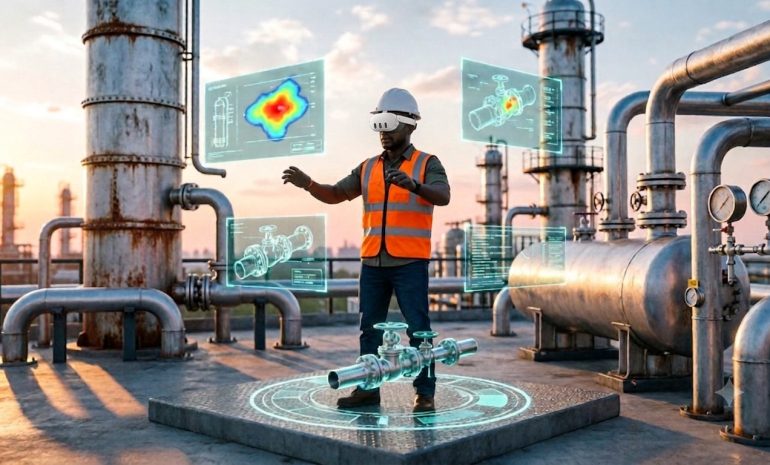
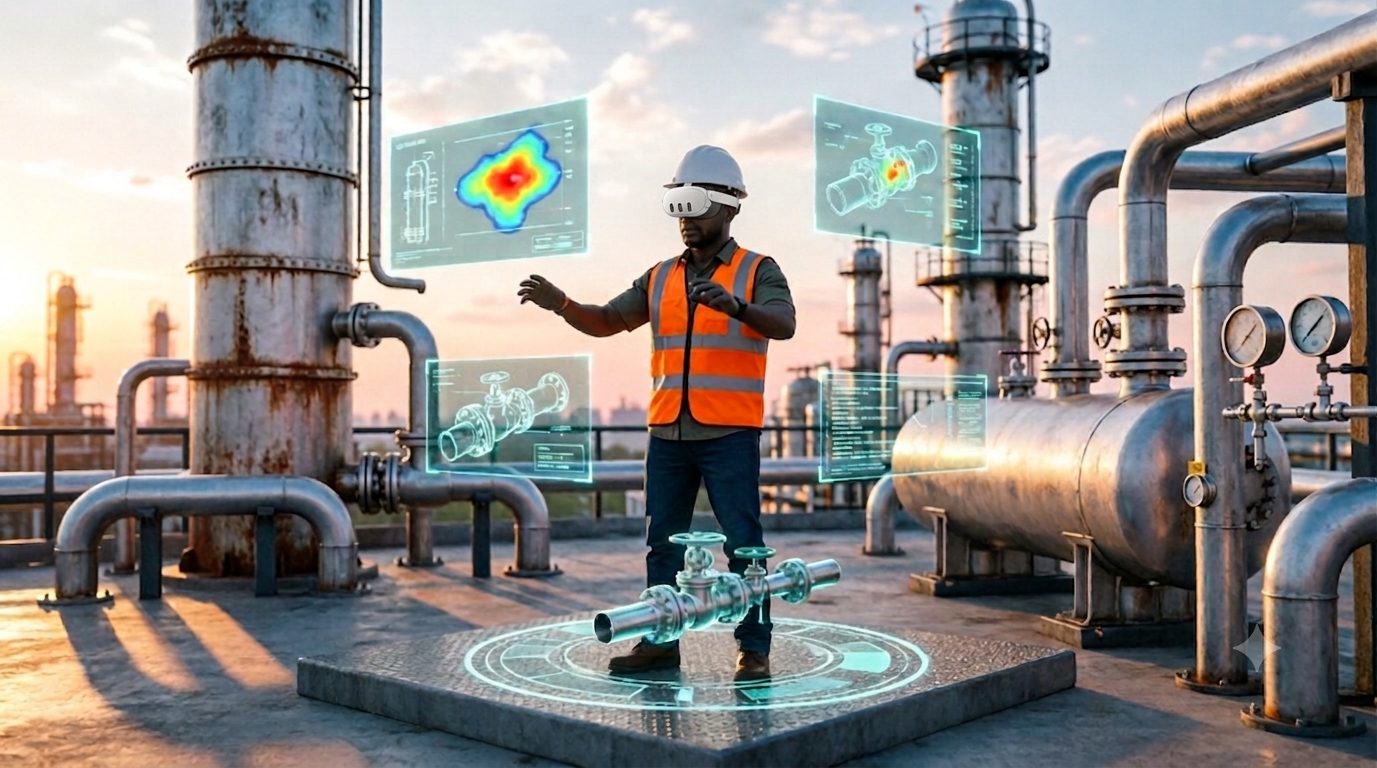
XR allows technicians to interact with virtual equipment, practise maintenance procedures, and troubleshoot faults in a controlled environment before working on the actual asset.
The real value lies in giving technicians the opportunity to learn through repetition without disrupting operations. They arrive on site with greater confidence, make fewer mistakes, and become productive much faster.
3. Remote Collaboration with AR and Mixed Reality
Many oil and gas assets in Nigeria are located in remote or offshore locations, where getting specialist support can take valuable time and resources. AR and MR solve this problem in slightly different but complementary ways.
With AR, a technician’s headset or tablet overlays digital information, such as schematics, torque values, or step-by-step instructions, directly onto the physical equipment in front of them, guiding their work without needing a remote expert present at all.
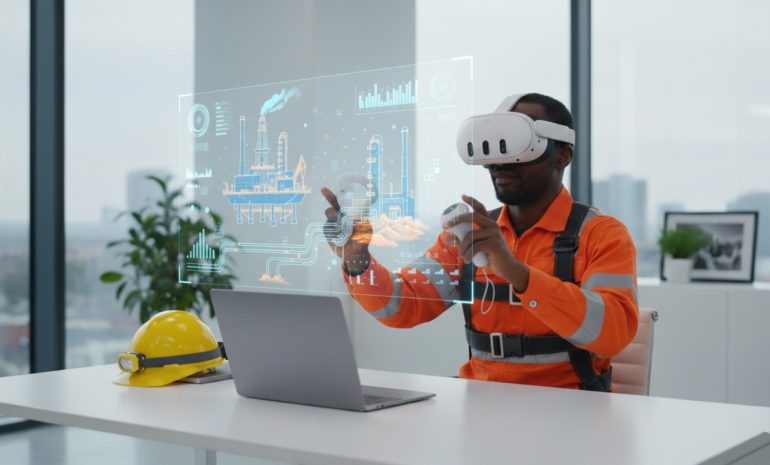
With MR, that same technician can go a step further: a specialist in another location sees exactly what the technician sees and can annotate the real environment in real time, virtually pointing at a valve or highlighting a component as if standing right there. This is especially valuable for offshore rigs, remote sites, and cross-border expert collaboration.
Together, the two shift technical support from something that has to travel to something that arrives instantly. Issues get resolved faster, travel costs drop, and knowledge moves from experienced engineers to field teams without anyone boarding a flight.
4. Immersive HSE Training
Health, Safety, and Environment (HSE) training is essential, and industry organizations such as the International Association of Oil & Gas Producers publish safety guidelines and recommended practices that many operators follow. XR makes these procedures more engaging by allowing workers to practise them in immersive environments.
XR transforms safety training into an interactive experience. Workers can identify hazards, practise permit-to-work procedures, use the correct PPE, and respond to realistic workplace scenarios.
Because employees learn by doing rather than simply listening, the training sticks. Retention improves, safety awareness becomes second nature, and procedures that once lived only on paper get applied with real confidence on the job.
5. Virtual Site Familiarization
For new employees and contractors, learning the layout of a refinery, production facility, or offshore platform can take time.
With VR, organizations can recreate their facilities as immersive digital environments. Before employees ever arrive on site, they can walk through the plant, locate emergency exits, identify hazard zones, and understand how different operational areas connect.
Onboarding stops being a first-day scramble to learn the building and becomes a formality. Supervisors, in turn, spend less time on orientation and more time developing the practical skills that actually make someone useful on site.
More Than Just a Training Tool
As Nigeria’s oil and gas industry continues its digital transformation, companies need smarter ways to prepare a workforce that can operate safely and efficiently in increasingly complex environments.
XR bridges the gap between theory and hands-on experience by allowing employees to practise, make mistakes, and build confidence before entering a live operational environment. We’ve seen this play out directly in our own project work, from high-precision 3D asset capture used to build accurate digital twins of industrial structures, to immersive learning environments designed around real curriculum standards. In both cases, the same principle holds: people learn faster and retain more when they can interact with an environment rather than just read about it.
The impact extends beyond the training room. Organizations can reduce reliance on expensive live training exercises, standardize learning across multiple sites, accelerate onboarding, and develop teams that are better prepared to perform safely from day one.
At Insightful3D, we work with oil and gas organizations to design immersive training solutions that address real operational challenges. Whether your goal is to strengthen safety training, improve equipment familiarization, or prepare teams for high-risk environments, we can help you identify where XR will deliver the greatest value.